
On the African continent, one in two students has never touched a keyboard connected to the internet in a school setting. However, digital education in Africa is developing rapidly, driven by local initiatives and national strategies that go beyond mere experimentation. With uneven connectivity, teacher training, and the need to adapt educational content, the task remains monumental, but recent advancements are changing the game.
Guidelines on Educational AI: An Unprecedented Regional Framework in Francophone Africa
When we talk about educational technologies, we often think of tablets or online course platforms. Artificial intelligence is now entering the equation, along with its regulation.
In July 2026, six Francophone African countries adopted common guidelines for ethical, inclusive, and responsible artificial intelligence. These guidelines include a specific section on educational uses: protection of student data, algorithmic non-discrimination, and transparency of tools used in the classroom.
In practical terms, this means that an adaptive learning software deployed in Senegal or Côte d’Ivoire must adhere to shared rules. Before this adoption, each country was moving forward alone, with pilot projects lacking coordination. We are shifting from a makeshift approach to a regional harmonization of the educational AI framework, which also facilitates partnerships between states and funding from international cooperation actors.
To better understand the projects that accompany this digital transformation on the ground, you can visit the Sankore website, which documents open educational resources adapted to the African context.
National Strategies for Educational Digitalization: The Case of Senegal 2025-2029
Have you noticed that many articles on digital education in Africa remain at the level of general observations? Things are changing with concrete action plans.
Senegal has launched a Digital Strategy for Education covering the period 2025-2029. This plan is not limited to distributing computers. It articulates three specific axes: deployment of connectivity infrastructure in rural areas, continuous training of teachers in digital tools, and production of educational content in local languages.
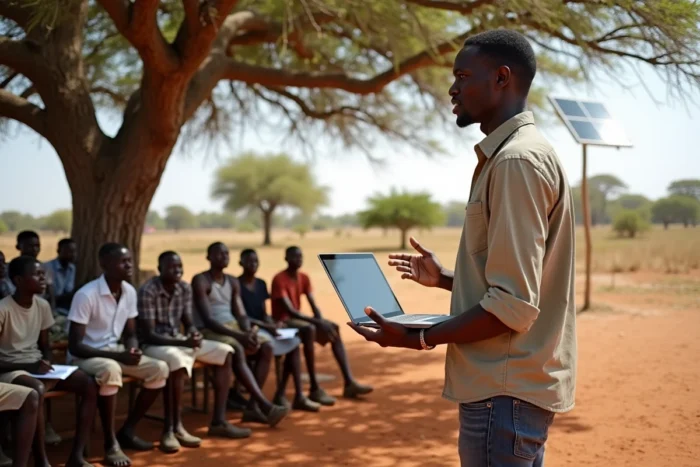
The financing aspect involves partnerships with telecom operators, who provide bandwidth at negotiated rates for educational institutions. This public-private cooperation model helps to overcome a classic obstacle: the cost of connectivity in sparsely populated areas.
This multi-year approach, with measurable objectives and identified partners, contrasts with one-off initiatives that fizzle out after the pilot phase. Other countries are observing this model to structure their own roadmaps.
Practical Learning and Local Content: What Global Platforms Lack
Major online course platforms (MOOCs, university e-learning) have opened access to knowledge. Their limitations quickly become apparent when the content does not align with local school curricula or the daily realities of learners.
A science course designed for a French high school student does not work as is for a Togolese or Burkinabé student. Examples, illustrations, and sometimes even the language of instruction create a disconnect. Educational content adapted to the African context remains scarce on major international platforms.
Several recent initiatives are attempting to fill this gap:
- Projects to create open educational resources in African languages, led by networks of local teachers and supported by organizations like AUF (Agence Universitaire de la Francophonie).
- Practical education platforms that integrate digital skills modules directly related to local economic sectors (agriculture, health, services).
- Training workshops for teachers, focused on using collaborative tools and AI in their courses, such as those documented at the Alassane Ouattara University in Bouaké.
The challenge is not only technological. Producing local educational content requires time, trained authors, and sustainable funding. Without these three elements, platforms remain empty shells once the initial grant is exhausted.
Teacher Training in Digital Tools: The Often Overlooked Link
Distributing tablets without training those who use them in the classroom is like offering a piano without sheet music or music lessons. Teacher training remains the weak point of most digital transformation projects in education.
Why this gap? Because budgets are often directed towards equipment, which is more visible and easier to account for than a continuous training program. A computer can be photographed, while a trained teacher’s impact is measured over several years.

Some countries are beginning to reverse this logic. In Togo, training sessions on digital tools are organized directly in schools. The goal is for each teacher to integrate a digital tool into their teaching practice, even with limited connectivity.
Training must also include a critical component: teaching teachers to evaluate the reliability of online content, understand the biases of an AI tool, and protect their students’ data. Without this dimension, digital tools risk amplifying problems instead of solving them.
Digital Sovereignty and Educational Development in Africa
The issue goes beyond pedagogy. Digital sovereignty conditions the sustainability of digital education on the continent. If servers, software, and student data are hosted and controlled abroad, African countries remain dependent on decisions made elsewhere.
A recent article from Financial Afrik framed the problem this way: the real challenge for Africa is not technological; it is human. Training developers, network engineers, and instructional designers capable of creating and maintaining local digital educational systems takes a generation.
The guidelines adopted in July 2026 on educational AI go in this direction: establishing common rules also asserts a capacity for self-regulation. Projects that succeed in the long term are those that combine technological innovation with the building of local skills, not those that import turnkey solutions.
Digital education in Africa is advancing in fits and starts, with enormous disparities between countries and between urban and rural areas. Multi-year strategies like that of Senegal, regional frameworks on AI, and efforts to produce local content outline a trajectory. The decisive factor remains the ability to train teachers on a large scale and to finance these programs over the long term, well beyond grant cycles.