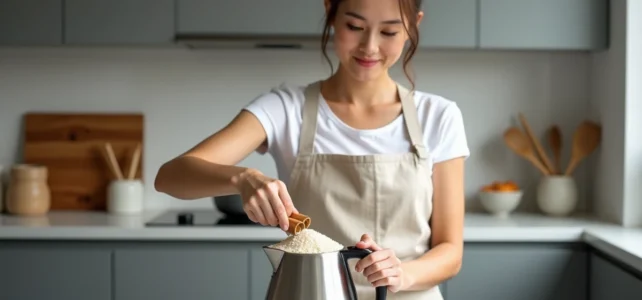
Hotel room without a plate, student studio with two wall outlets, construction site desk where the only source of heat is a 1.5-liter kettle: we’ve all experienced that situation where preparing a hot meal is a logistical challenge. Rice, the quintessential staple food, is well-suited to this type of constraint, provided you understand how the electric kettle manages (or does not manage) temperature once boiling is reached.
Why the kettle shuts off before the rice is cooked
Most electric kettles are equipped with a bimetallic thermostat that cuts off power as soon as steam reaches the sensor. With just water, this takes a few minutes. With rice that absorbs water and reduces the liquid volume, the thermostat triggers too early, sometimes before the grains have had time to cook.
So, we are working against the logic of the device. The entire method relies on one principle: manually restart the boiling several times, or take advantage of residual heat between cycles. Kettles without automatic shut-off (rare, often older models) simplify the task but pose an obvious safety issue if you step away.
To successfully cook rice in the kettle, you must anticipate these shut-offs and adjust the amount of water accordingly, which changes the game compared to a traditional pot.
Water and rice ratio suitable for the electric kettle
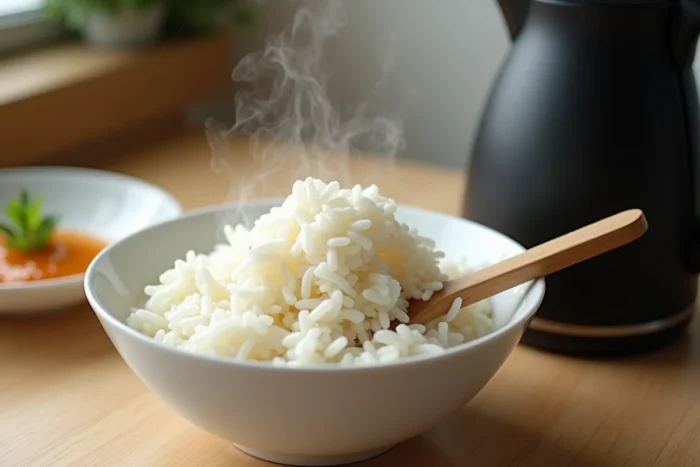
In a pot, we often use one and a half volumes of water for one volume of rice. In a kettle, this ratio needs to be increased. Evaporation is faster (the lid is not airtight on most models), and each restart of the button causes a new phase of vigorous boiling that expels steam.
Counting about two volumes of water for one volume of rice provides a sufficient margin. It’s better to drain a slight excess at the end of cooking than to end up with crunchy grains stuck to the bottom of the heating element.
Rinsing before cooking
Rinsing the rice under cold water remains a useful step, especially in a kettle. The surface starch forms a foam during boiling that can overflow from the spout. Three rinses in a bowl or under running water, until the water becomes fairly clear, are enough to limit this issue.
Which type of rice works best
Basmati and long-grain Thai rice yield the best results. Their grains remain separate and absorb water evenly. Round rice or sushi rice, which are higher in starch, tend to stick more and risk forming a compact block against the heating element.
Rice cooking method in a kettle, cycle by cycle
Now we get into the specifics. Here’s the sequence that reliably works with a standard kettle of 1 to 1.7 liters:
- Pour the rinsed rice and cold water into the kettle, then start the first boil normally. The kettle will shut off by itself.
- Wait one to two minutes, with the lid closed, to let the residual heat work, then restart the button. Repeat this process three to five times depending on the power of the device.
- After the last cycle, let the rice rest with the lid closed for about ten minutes without reopening. It’s this resting phase that completes the absorption and yields a tender grain.
- Taste a grain before serving. If it remains firm in the center, restart an additional cycle with an extra tablespoon of water.
Feedback varies on the exact number of restarts needed, because the power of kettles differs from model to model. Generally, three restarts are mentioned for a powerful kettle and up to five for an entry-level model.

Kettle maintenance and its impact on cooking
A scaled kettle heats more slowly and unevenly. When used solely for tea water, this translates to a few extra seconds. For cooking rice, the effect is more pronounced: scale prolongs each cycle and skews the evaporation ratio.
Regular descaling with white vinegar (fill, bring to a boil, let sit, rinse) maintains the heating element’s performance. This is even more true if you use the kettle to cook rice regularly, as residual starch accelerates deposits.
Cleaning after each rice cooking
Rice leaves a film of starch on the walls and around the heating element. Filling the kettle with hot water just after emptying the rice, letting it soak for a few minutes, then gently scrubbing with a non-abrasive sponge prevents this deposit from hardening.
Safety limits of a kettle used outside its primary purpose
The electric kettle is designed to heat water, not to cook solid foods. Using the kettle for rice remains a stopgap measure, not a daily habit. The immersed heating element can overheat if the water level drops too low during cooking, and starch splashes at the spout or steam sensor can disrupt the thermostat.
A few practical precautions reduce risks:
- Never leave the kettle unattended during restart cycles.
- Avoid filling beyond two-thirds of the maximum capacity (rice increases the total volume).
- Do not use a kettle with a thin plastic bottom, as prolonged heat can warp the material. Stainless steel or glass models handle this alternative use better.
For regular rice cooking, a small rice cooker is more suitable. Its automatic shut-off is calibrated to the grain’s water absorption, with an integrated keep-warm function, eliminating the constant monitoring that a kettle requires.
The kettle remarkably helps out when you have nothing else on hand. With the right water ratio, careful rinsing, and the patience to restart a few cycles, you can achieve perfectly acceptable rice. The device then returns to its primary function without damage, provided you clean it right afterward.