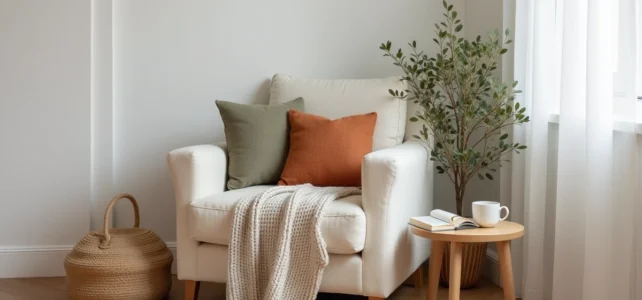
A cozy home interior is not based on the accumulation of throws and candles. It is built on precise technical choices: color temperature of light sources, density of textiles, compatibility of materials with each other. Here, we detail the levers that truly transform a room into an enveloping space, far from the usual decorative lists.
Color temperature and CRI: the technical foundation of a cocooning atmosphere
A cozy ambiance primarily plays on the light spectrum. We recommend sources between 2,200 K and 2,700 K for the living room and bedroom. Beyond 3,000 K, the light turns to cold white and immediately breaks the feeling of enclosure, regardless of the furniture in place.
The color rendering index (CRI) is just as important as the temperature. A CRI above 90 accurately reproduces the warm tones of textiles and woods. Cheap LED strips often have a CRI around 70, which dulls colors and gives a flat appearance to the decor.
Multiply low-intensity light points rather than relying on a single ceiling fixture. Three low sources (table lamp, reading lamp, garland) create soft shadow areas that add depth to the room. You will find complementary approaches on the home page of Le Blog de Coco, which explores other aspects of interior design.
Cocooning palette 2026: terracotta, sage green, and deep shades
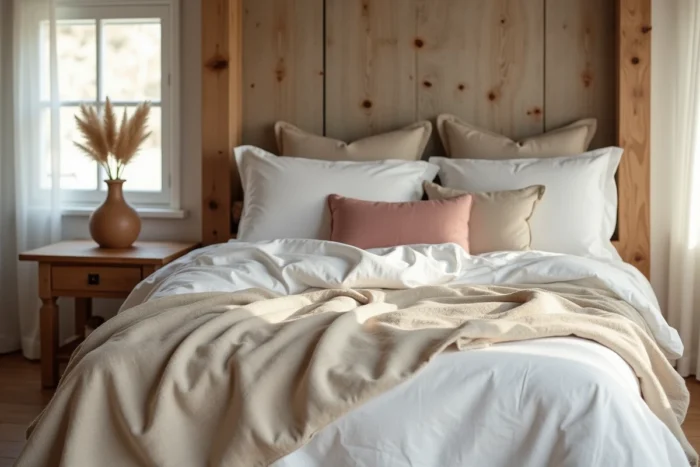
The ubiquitous neutral palettes in decor articles (off-white, greige, linen) remain safe bets, but the trends for 2026 steer cocooning towards bolder tones. Terracotta, sage green, deep red, old rose, and midnight blue are the colors identified to create interiors that are both warm and contemporary.
Olive green and celadon work particularly well in north-facing living spaces, where they compensate for the lack of warm natural light. Straw yellow, used in touches (cushions, vase, frame), warms up a living room without saturating the space.
Combining these colors without a taste faux pas
The rule we apply: a dominant shade on the walls (sage green, for example), a complementary shade on the main textile (terracotta on the sofa or bed throw), and a third as a punctuated accent. A maximum of three colors per room. Beyond that, the eye no longer knows where to settle, and the cocoon effect disappears.
Always test a paint sample directly on the targeted wall, in natural light and in evening artificial light. A shade that seems soft in the store can become aggressive under lighting at 4,000 K.
Textiles and materials: density, natural fibers, and layering
Cocooning relies on touch as much as on sight. The choice of fibers determines the durability of the ambiance. Low-cost synthetic fibers (fine polyester, acrylic) lose their softness after a few washes and accumulate static electricity.
- Washed linen gains in flexibility over time and naturally regulates humidity, making it suitable for both the bedroom and the living room.
- Merino wool or mohair offers a high insulating power for a moderate weight, ideal for throws and sofa cushions.
- Brushed cotton (flannel) is suitable for winter bed linen: it warms up upon contact, unlike percale cotton which remains cool.
- Corduroy, a strong trend for two seasons, adds a rich visual texture to seating and headboards.
Layering does the rest. A bare sofa, even in velvet, is not enough. Add a wool throw placed on the armrest, two cushions of different textures (one smooth, one knitted), and a short-pile rug under the coffee table. A minimum of three textile levels per seating area to achieve the cocoon effect.
Light and breathable floors: the end of thick rugs everywhere
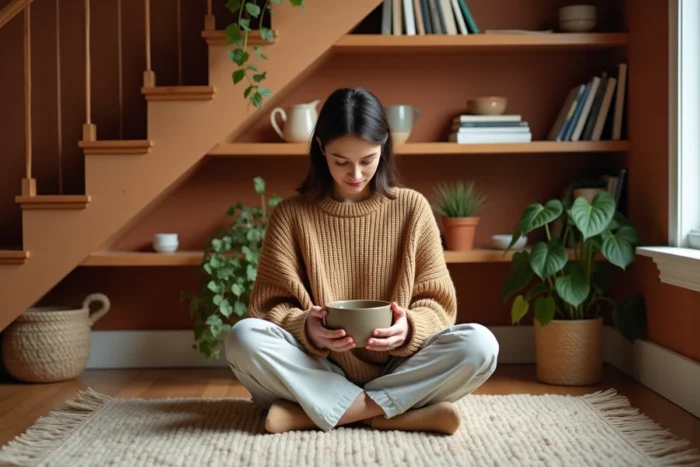
The 2026 trend documented by several decor sources marks a retreat from large long-pile rugs in favor of more breathable coverings. Natural fibers (jute, sisal) and wood-look LVT tiles simplify maintenance while retaining a warm aesthetic. Reserve the plush rug for the bedside or a well-defined reading corner, not for the entire living room surface.
Arranging the living room and bedroom for a cozy space
The most common mistake: pushing all the furniture against the walls. This arrangement creates an uncomfortable central void. Bringing seating closer around a focal point (fireplace, coffee table, bookshelf) reduces distances and fosters a sense of intimacy.
In the bedroom, the headboard plays a structuring role. A padded or fabric-covered headboard (linen, velvet) absorbs some of the ambient noise and adds a layer of texture. Position the bed so that it does not face directly towards the door: this simple offset enhances the feeling of refuge.
- Favor furniture with rounded corners rather than sharp edges, which visually disrupt the softness of the room.
- Incorporate an armchair or chaise longue in a corner of the bedroom to create a reading area distinct from the bed.
- Limit reflective surfaces (glass, chrome metal) in favor of wood, rattan, or matte ceramics.
Cocooning decoration is not just a style. It is a set of technical decisions about light, color, textiles, and layout that, combined, produce a tangible result. A living room where the color temperature drops below 2,700 K, where three textures layer on the sofa, and where the seating converges towards a center, no longer needs artifice to make you want to stay.