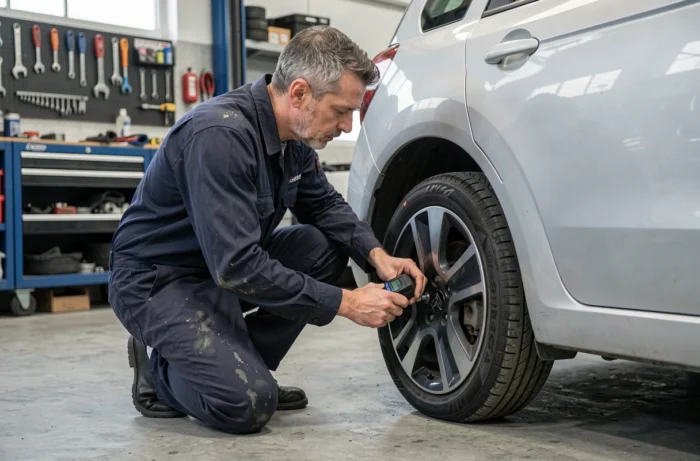
The tire pressure of the Citroën C2 varies depending on the engine type, tire size, and vehicle load level. Knowing the exact value for each configuration prevents premature wear, limits fuel consumption, and maintains the handling of this city car.
Manufacturer’s label and owner’s manual: where to find the tire pressure for your Citroën C2
Citroën indicates the inflation values at three locations on the C2: the label affixed to the driver’s door pillar, the fuel filler flap, and the vehicle’s user manual. These three sources refer to the same data, expressed in bar.
The door label remains the quickest reference. It mentions the original tire size, front pressure, rear pressure, and, if applicable, the pressure when loaded. If the label is worn or missing, the owner’s manual provides a complete table by engine type. To find the recommended tire pressure for Citroën C2 based on your engine, you first need to identify the exact size indicated on the tire sidewall.
This inscription takes the form of a code like 175/65 R14 82T. The first number (175) corresponds to the width in millimeters, the second (65) to the aspect ratio, R14 to the rim diameter in inches, and the last characters to the load index and speed rating. Each engine/size combination has its own target pressure.
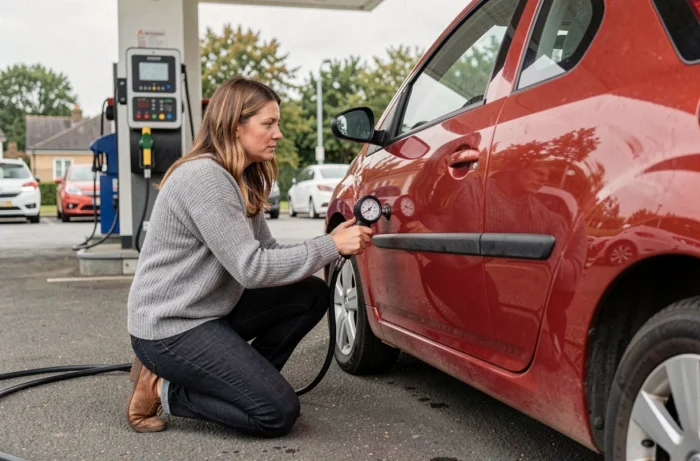
Tire pressure table for Citroën C2 by engine type
The values below correspond to the manufacturer’s recommendations based on the engine type and the original tire size fitted.
| Engine | Tire Size | Front (normal) | Rear (normal) | Front (loaded) | Rear (loaded) |
|---|---|---|---|---|---|
| 1.1 i | 175/65 R14 82T | 2.2 bar | 2.2 bar | 2.2 bar | 2.2 bar |
| 1.4 HDi | 175/65 R14 82T | 2.5 bar | 2.5 bar | 2.5 bar | 2.5 bar |
| 1.4 i | 175/65 R14 82T | 2.3 bar | 2.3 bar | 2.3 bar | 2.3 bar |
| 1.4 i | 185/55 R15 82H | 2.3 bar | 2.3 bar | 2.3 bar | 2.3 bar |
| 1.6 i 16V | 195/45 R16 80V | 2.4 bar | 2.4 bar | 2.4 bar | 2.4 bar |
It is noted that diesel engines (1.4 HDi) require a higher pressure than equivalent petrol versions. The HDi block is heavier, which increases the load on the front axle.
Normal load and loaded vehicle on the C2
The “loaded” column corresponds to use with a full trunk and several passengers. On some city cars, the increase between driving empty and driving loaded reaches about 0.2 bar extra. On the C2, the manufacturer’s values remain the same in both configurations for most engines, simplifying daily adjustments.
This feature does not exempt from checking before a loaded trip (vacation, moving). The actual weight can exceed the standard “loaded” configuration if the vehicle approaches its maximum allowed load.
Effect of temperature on the tire pressure of your C2
The pressure inside the tire fluctuates with the outside temperature. A drop of 10 °C results in a loss of about 0.1 bar. In winter, a tire inflated to 2.3 bar in a heated workshop can drop below 2.1 bar once the vehicle is parked outside in cold weather.
To compensate for this phenomenon, it is recommended to add about 0.2 bar to the manufacturer’s table values during the coldest months. This slight winter over-inflation brings the effective pressure back to the nominal value once the tire reaches operating temperature.
Cold pressure and hot pressure
Pressure checks should always be done on cold tires, meaning after at least two hours of standing or less than three kilometers driven at low speed. A hot tire shows an artificially high pressure due to the heating of the internal air.
If the check occurs after a drive, the value read on the gauge will be higher than the actual cold pressure. Deflating to reach the nominal value under these conditions would lead to under-inflation once the tire cools down.
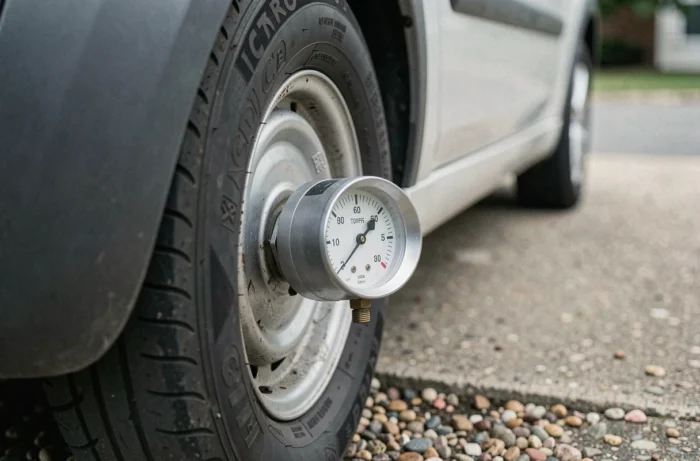
Gauge and frequency of checks for a Citroën city car
Tire pressure is measured using a gauge, available at gas stations (inflation stations) or in portable versions. Portable digital gauges offer more accurate readings than some older gas station units.
The recommended check frequency is as follows:
- Every two weeks during daily use, to detect a slow loss due to a micro-puncture or a faulty valve
- Before each long trip (highway, vacation), especially if the vehicle is loaded
- At each change of season, to adjust the pressure to temperature variations
TPMS light and pressure sensors
Some recent versions of the C2 may be equipped with a TPMS (Tire Pressure Monitoring System) that alerts the driver in case of significant pressure loss. This system does not replace manual checks: it only activates when the pressure drops significantly below the threshold, often too late to prevent already initiated asymmetric wear.
Consequences of improper inflation on the Citroën C2
An under-inflated tire wears more quickly on the edges of the tread. Rolling resistance increases, which burdens fuel consumption. On a lightweight city car like the C2, the effect on handling is even more noticeable due to the low ground clearance.
An over-inflation wears the center of the tread and reduces the contact area with the ground. Braking efficiency decreases, and ride comfort deteriorates, especially over speed bumps and rough roads.
- Under-inflation: edge wear, increased consumption, risk of overheating and blowout at high speed
- Over-inflation: central wear, extended braking distance, excessive bouncing
- Correct pressure: even wear, appropriate consumption, maximum grip
The tire pressure of the C2 can be checked in a few minutes and costs nothing. A difference of 0.2 to 0.3 bar is enough to change the vehicle’s behavior and measurably shorten the tire’s lifespan.