
Quality education is based on concrete, measurable parental practices that impact a child’s development. It is not limited to schooling: it encompasses emotional management, structuring daily life, and the ability to adapt the family environment to the real needs of each age. Here are five specific levers, supported by recent data, to anchor this approach in daily life.
1. Reasoned screen management before age 6
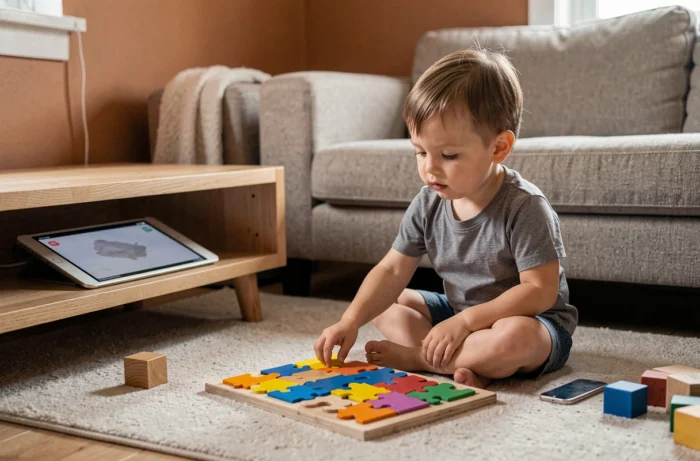
A study by Santé publique France published in 2023 shows that a 2-year-old spends an average of 56 minutes a day in front of a screen, while the WHO recommendation remains total screen absence before age 3. This gap has documented consequences reported by field professionals.
Observations reported by the APAJH Federation indicate an increase in language delays, attention difficulties, social interaction disorders, and sleep disturbances in young children who are heavily exposed. These signals are not a moral panic, but a repeated clinical observation.
Several resources detail quality education on Club des Parents by integrating this digital dimension, often absent from traditional approaches focused solely on kindness. The Screen Commission, in a 2024 report, confirms that the quality of the content viewed is as important as the duration of exposure: an interactive cartoon watched with a parent does not have the same effect as passive video streaming.
In practical terms, this means defining screen-free times (meals, the hour before bedtime) and replacing passive time with activities that engage language and motor skills.
2. Emotional transmission through the mirror effect

Apart from organic reflexes, children learn by imitating. Laurence Dudek, psychotherapist and author of “Kind Parents, Aware Children,” reminds us that non-verbal communication represents the vast majority of this transmission. A child absorbs their parent’s emotions even before understanding words.
This mechanism has a direct consequence on learning. An angry or anxious parent transmits this emotional charge, and unpleasant emotions like fear or guilt hinder memorization. The child then obeys through conditioning, without understanding what is expected of them or why.
In practice, this involves working on one’s own emotional regulation before correcting a behavior. Naming one’s emotion aloud (“I am frustrated because…”) provides the child with a management model they will gradually replicate. This is not an abstract technique: it is the foundation of parent-child co-regulation, documented in developmental psychology.
3. Stable rule framework with autonomy margins
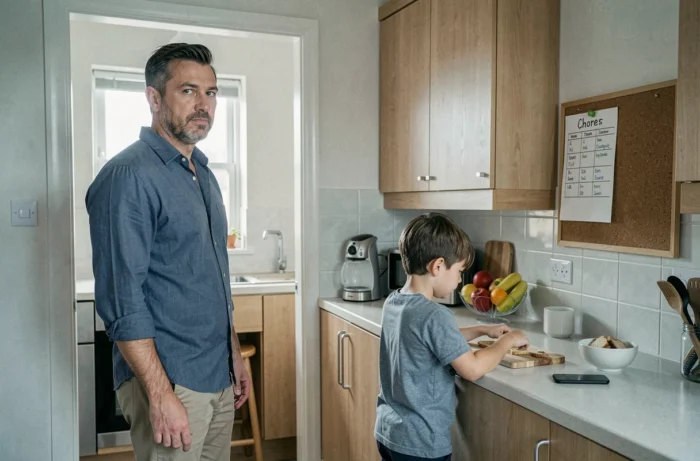
An educational framework only works if it combines two elements: clear rules and an age-appropriate freedom zone. The absence of rules generates insecurity, while excessive rules hinder the development of autonomy. The goal is to set coherent limits that the child can anticipate.
Rules should be few and positively phrased. “We walk inside” works better than “don’t run” because a child’s brain processes an action instruction more easily than a prohibition.
The margin of autonomy is built through framed choices. Offering two snack options, allowing the child to choose their clothes from a selection appropriate for the weather, or assigning them a manageable household task: each micro-decision reinforces the sense of competence. This process follows a natural progression:
- Before age 3: simple binary choices (this fruit or that one), participation in daily tasks (putting away a toy after use)
- Between ages 3 and 6: gradual responsibilities (setting the table, watering a plant), short explanations of the “why” behind each rule
- After age 6: framed negotiation on certain topics (reading time, weekend activity), logical consequences rather than arbitrary punishments
4. Active listening focused on emotional validation

Active listening in an educational context does not mean accepting everything. It involves acknowledging the child’s emotion before addressing the behavior. A child who hits because they are frustrated needs to hear “you are angry” before hearing “we don’t hit.”
This sequence (validation then reframing) works because it deactivates the stress response. A child whose emotion is denied (“but no, you have no reason to be sad”) learns to suppress their internal signals, complicating their long-term regulation ability.
Concrete techniques are simple to implement:
- Get down to the child’s physical level to establish eye contact
- Rephrase what the child expresses (“you are disappointed because you wanted to stay at the park”)
- Offer an alternative after validation (“we’ll come back tomorrow, now let’s prepare dinner together”)
- Avoid minimizations (“it’s nothing”) that cut off communication
This approach requires time in the moment, but gradually reduces the frequency of crises because the child feels understood and develops their own emotional vocabulary.
5. Family environment structured by predictable routines

The predictability of daily life acts as a safety net for a child’s development. Routines are not rigidity: they provide a stable temporal foundation that frees cognitive energy for learning and exploration.
An identical bedtime ritual each night (tooth brushing, story, cuddle, lights out) prepares the brain for sleep much more effectively than an imposed bedtime without transition. The body anticipates the sequence and adjusts to it.
Shared meals constitute another pillar. They offer a structured conversation space where the child practices turn-taking, enriches their vocabulary, and observes social codes. The regularity of meal times also has a direct effect on appetite regulation and overall nutritional quality.
Quality education does not rely on a single method or a perfect theoretical model. It is built through the repetition of daily gestures adjusted to the age, personality of the child, and the real constraints of each family. The five levers described here share a common point: they require consistency rather than perfection.