
In artistic gymnastics, an individual competition is structured in several successive rounds where each gymnast is evaluated on all the apparatus of their discipline. The final score combines two distinct components, difficulty and execution, according to an open-ended scale system that has governed international competitions since the mid-2000s.
Difficulty score and execution score: the foundation of judging in gymnastics
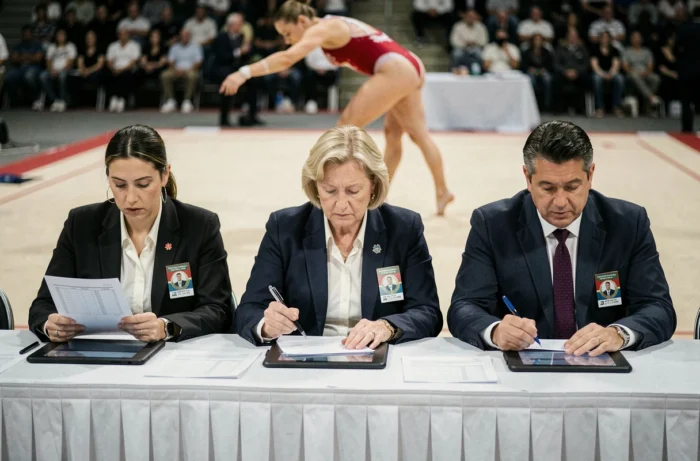
The scoring system relies on a clear separation between two panels of judges. The first evaluates the difficulty score (D), which has no maximum ceiling: it adds up the value of each acrobatic or technical element presented in the routine. The more complex figures the gymnast incorporates, the higher this score rises.
The second panel assigns the execution score (E), which starts from 10 and decreases with each mistake: unbalanced landing, bent legs, missed catch. Additional penalties may apply, for example, for exceeding time on the floor or stepping out of bounds.
The final score is obtained by adding D and E, then subtracting any penalties. This mechanism, confirmed for the 2025-2028 cycle, allows a gymnast to compensate for a less clean execution with significantly higher difficulty. As explained by the site En forme chaque jour, this scoring logic directly shapes the strategy of each competitor in individual events.
Qualifications and individual all-around competition: how the rounds unfold
A high-level individual competition is divided into clearly distinct phases. It all begins with a preliminary round, often called qualifications, where all registered gymnasts perform on each apparatus.
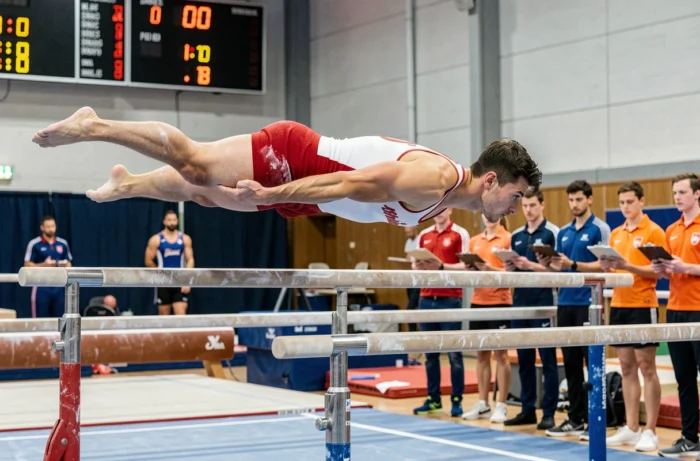
In WAG (women’s artistic gymnastics), this includes four apparatus: vault, uneven bars, balance beam, and floor. In MAG (men’s artistic gymnastics), there are six apparatus: floor, pommel horse, rings, vault, parallel bars, and high bar. The scores obtained on all apparatus determine the provisional ranking.
The highest-ranked gymnasts then advance to the final of the individual all-around competition. At world championships or the Olympics, this field is limited to a small number of qualifiers. Scores from the preliminary round are not carried over: each finalist starts from zero and must perform on all apparatus again.
This two-phase format creates particular tactical pressure. In qualifications, some gymnasts present slightly lighter routines to secure their passage. In the final, they increase the difficulty to aim for the podium.
Apparatus finals in artistic gymnastics: a format distinct from the all-around competition
Beyond the all-around competition, individual competitions include apparatus finals. These are separate events where only the score on one apparatus counts. Selection for these finals also occurs during the preliminary round, based on the best score obtained on each apparatus.
In practice, a gymnast can qualify for the all-around competition and for one or more apparatus finals. Profiles differ based on strategy:
- All-rounders aim for the all-around competition by maintaining a consistent level across all apparatus, even if it means limiting difficulty on certain devices.
- Specialists focus their preparation on one or two apparatus, presenting routines with very high difficulty, and may sometimes not participate in the all-around competition.
- Some gymnasts combine both approaches by presenting a lighter program on their secondary apparatus in qualifications, then reserving their best figures for the targeted apparatus final.
In the apparatus final, each competitor performs only once. The difficulty score often reaches its highest levels here, as gymnasts no longer have to distribute their energy across four or six routines.
Rotation on apparatus and practical organization of a competition field
From a logistical standpoint, individual competitions operate through simultaneous rotation on all apparatus. Gymnasts are divided into groups (sometimes called subdivisions during major competitions). Each group starts on a different apparatus, then moves to the next after a defined time.
In MAG, with six apparatus, a group performs six rotations. In WAG, four rotations are sufficient. Between each rotation, a timed warm-up is allowed on the next apparatus. This system enables a large number of gymnasts to compete in one day while ensuring minimal recovery time.
The order of performance within a group is generally drawn by lot or set by previous rankings. Going last on an apparatus can provide a psychological advantage: the gymnast knows the scores of their direct competitors and can adjust their risk-taking.
Tiebreakers and close scores in individual competition
Perfect ties remain rare, but the rules provide tiebreak criteria. In the event of identical scores in the all-around competition, the highest execution score breaks the tie. This choice is significant: it rewards technical cleanliness rather than the accumulation of difficulty.
For the apparatus finals, the same principle applies. If the tie persists after comparing execution scores, penalties are examined in detail. This system encourages gymnasts to pay attention to every detail of their movements, including elements linking the main figures.
Individual artistic gymnastics remains a sport where the margin between the podium and fourth place is often decided by a few tenths. Understanding the D + E mechanism, the tactical management of qualification rounds, and the choice between versatility and specialization are the three parameters that determine the final result of a gymnast in competition.