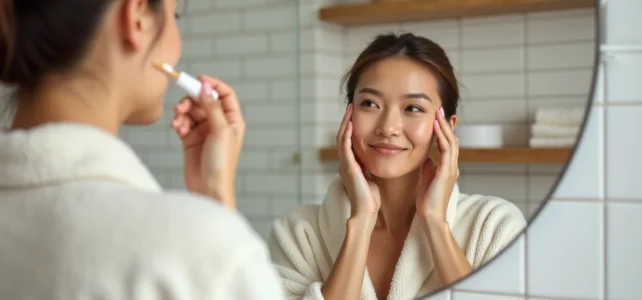
An effective beauty routine is based on a principle often overlooked: the order of application of products and their chemical compatibility matter more than their price or reputation. For example, applying a watery serum after an oil prevents water-soluble active ingredients from penetrating the epidermis. Elevating your daily beauty routine therefore requires a technical understanding of each step, not just the accumulation of bottles.
Texture and molecular weight: the logic of layering treatments
Each cosmetic product has a molecular weight that determines its ability to cross the skin barrier. The smallest molecules (low molecular weight hyaluronic acid serums, for example) should be applied first, on clean and slightly damp skin.
Next comes the oil phase: plant oils, balms, or rich creams. These textures form an occlusive film that retains the hydration provided by the previous layers. Reversing this order is like putting on a raincoat before a sweater: the heat does not diffuse.
To refine this logic, several specialized resources detail the compatibilities between actives according to skin types. The advice published on Blog Beauté allows for cross-referencing textures with the specific needs of each epidermis, whether oily, dry, or reactive.
- Apply watery formulas first (tonic lotions, essences, water-soluble serums), then light emulsions, and finish with oily textures (oils, balms)
- Wait about thirty seconds between each layer to allow the product to penetrate before layering another
- Reserve potentially irritating actives (retinol, exfoliating acids) for the evening, when the skin enters its cellular regeneration cycle
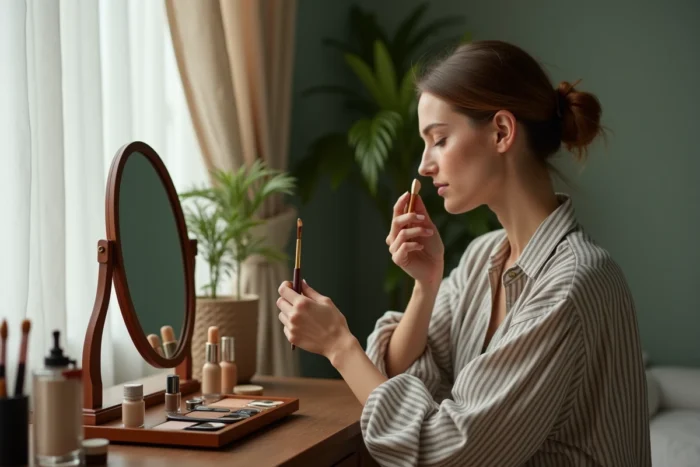
Daily sun protection: a beauty gesture often underdone
Sun protection remains the most documented anti-aging treatment in dermatological literature. Applying SPF only in the summer or on sunny days does not protect against UVA rays, which are present year-round, even behind an office window.
The most common problem is not the absence of sunscreen, but the amount applied. Most users only apply one-third of the necessary dose to achieve the protection stated on the bottle. For the face, the right measure is approximately two lines of product along the index and middle fingers.
Sun filter and makeup: how to combine them
Apply sunscreen as the last step of your skincare routine, before makeup. The SPF in a foundation does not replace a dedicated sunscreen, as the amount of foundation applied is too low to guarantee the level of protection claimed. Sunscreen mists allow for reapplying protection throughout the day over makeup, without having to remove it all.
Labeling of cosmetic allergens: reading your bottles differently starting in 2026
The European regulation 2023/1545 mandates, starting July 31, 2026, an expansion of the list of fragrance allergens to be mentioned on the packaging of cosmetic products. This regulatory change directly affects the construction of a daily beauty routine.
Sensitive or reactive skin types are the first to be affected. Until now, several common allergenic substances in synthetic fragrances were not required to appear on the label. With this new framework, it becomes possible to more finely identify formulations likely to cause redness, tightness, or contact eczema.
In practical terms, when choosing a serum, moisturizer, or makeup remover, checking the INCI list beyond the first ten ingredients makes perfect sense. Fragrance allergens often appear at the end of the list, where few consumers read. This simple habit allows for excluding risky products before integrating them into a stable routine.

Multifunctional products and minimalist routine: reducing steps without losing results
The trend towards hybrid treatments (a single product combining hydration, protection, and complexion correction) responds to a growing demand for shorter routines. Fewer steps also mean fewer risks of incompatibility between actives and less mechanical friction on the skin.
A tinted moisturizer with integrated SPF can replace three products (day cream, sunscreen, light foundation) without sacrificing effectiveness, provided that each function is truly dosed correctly. The trap of low-quality all-in-one products lies precisely in the under-dosing of each active ingredient.
Criteria for evaluating a multifunctional treatment
- Check that the stated SPF is at least 30 and that it covers UVA (mention “broad spectrum” or circled UVA logo)
- Prefer a moisturizing base formulated with identified humectants (glycerin, hyaluronic acid) rather than a simple texture agent
- Test the coverage on the back of your hand before applying it to your face: a tinted treatment that is too opaque or too fluid for your skin tone will not last throughout the day
Daily mechanical gestures: what damages the skin without being seen
Rubbing a cotton pad on the eyelid to remove mascara, pressing hard on a grainy scrub, drying the face by rubbing with a towel: these repeated gestures weaken the skin barrier and accelerate sagging, especially around the eyes.
Patting rather than rubbing constitutes a minimal change that protects the hydrolipidic film. For eye makeup removal, placing a soaked cotton pad for a few seconds on the closed eyelid allows the product to dissolve the makeup without mechanical pulling.
The eye contour, whose skin is three to four times thinner than that of the rest of the face, deserves special attention. Applying an eye cream by gently tapping with the ring finger (the finger that naturally exerts the least pressure) is enough to make the product penetrate without stretching the tissues.
A daily beauty routine becomes more effective when each gesture respects the physiology of the skin rather than constraining it. Adapting the order of treatments, reading labels, and moderating mechanical pressure are three concrete levers that cost nothing and change the quality of the epidermis over time.