
Between feeding, veterinary care, hygiene, and physical activity, taking care of pets on a daily basis requires very different knowledge depending on the species. The needs of a sedentary cat only partially overlap with those of an active dog, and the most common mistakes lie in details that owners underestimate.
ACACED Certification: A Reliable Indicator for Choosing an Animal Professional
When entrusting your pet to a boarding facility, a dog trainer, or a daycare, the quality of supervision is based on a precise regulatory framework. Since the update of the RS7613 reference by France Compétences, anyone engaged in activities related to companion animals (shelter, care, training, sales) must hold the ACACED knowledge certificate and update it at least every ten years.
The update training lasts a minimum of seven hours and covers eight areas: feeding, behavior, housing, law, reproduction, animal health, transport, and selection. For an owner, checking that the chosen professional has this up-to-date certificate remains the simplest way to ensure that the care and environment provided are based on solid foundations.
Before reserving a spot in a boarding facility or signing a training contract, it is possible to discover care on Blog Animaux to compare recommended practices with advertised services.
Dog and Cat Feeding: The Differences That Matter
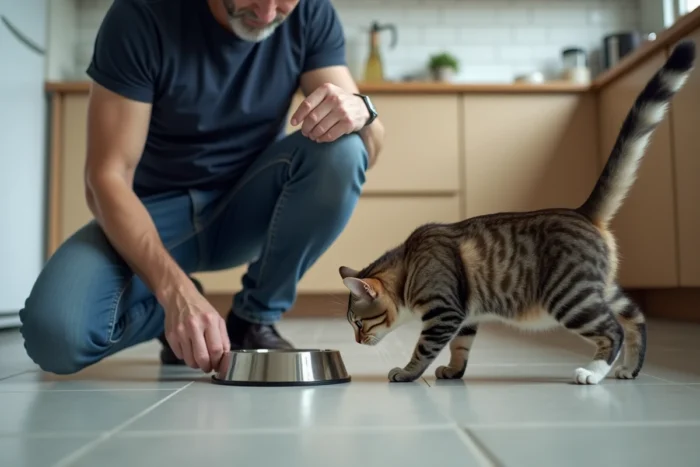
Feeding a dog and a cat with the same logic is a common mistake. Their metabolisms diverge on points that directly influence medium-term health.
| Criterion | Dog | Cat |
|---|---|---|
| Diet Type | Omnivore with a carnivorous tendency | Strict carnivore |
| Protein Needs | Moderate to high depending on activity | Consistently high |
| Taurine | Synthesized by the body | Must be provided by diet |
| Meal Frequency (adult) | 1 to 2 meals per day | Several small meals (natural grazer) |
| Hydration | Drinks spontaneously | Drinks little, wet food recommended |
The cat does not synthesize taurine, an amino acid whose deficiency causes heart and eye disorders. Feeding a dog diet to a cat creates a taurine deficiency within a few weeks. Conversely, cat kibble, richer in proteins and fats, promotes weight gain in dogs.
The hydration of the cat deserves particular attention. Cats descend from desert species and naturally drink little. A diet consisting solely of dry food (kibble) increases the risk of urinary problems. Alternating kibble and wet food, or adding a water fountain, compensates for this tendency.
Daily Hygiene: The Underestimated Actions by Owners
Hygiene care is not limited to bathing. Several regular actions prevent costly infections to treat.
- Rinse the animal with clear water after each swim in the sea, lake, or river to eliminate irritating residues (salt, algae, freshwater bacteria).
- Disinfect wounds, even superficial ones, with an antiseptic solution suitable for animals, never with a product intended for humans containing pure alcohol.
- Clean the eyes and ears weekly, especially in breeds with drooping ears (cocker, cavalier king charles) where moisture promotes ear infections.
- Ensure oral hygiene with an appropriate product or chewable items (bones, dental sticks) to limit tartar.
Keeping resting areas and bowls clean reduces bacterial proliferation. A water bowl changed once a day and a bed washed weekly is sufficient for most situations.
Parasite Control: Frequency and Vigilance
Treatment against external parasites (fleas, ticks) and internal ones (worms) is a cornerstone of animal health. An untreated animal can transmit certain parasites to humans, notably roundworms in young children.
The frequency of treatment varies according to lifestyle. An indoor cat requires fewer parasite treatments than a dog that frequents parks and underbrush. However, even a cat that never goes outside can catch fleas brought in by its owners’ shoes or clothing.

Physical Activity and Mental Stimulation According to Species
Daily exercise prevents obesity, behavioral issues, and chronic boredom. Needs vary significantly from one species to another, but also from one breed to another within the same species.
A herding dog deprived of physical and mental stimulation often develops destructive behaviors or anxiety. Walks alone are not enough: scent search games, recall in varied terrain, or obstacle courses engage the companion more than a monotonous walk on a leash.
For cats, stimulation comes from the indoor environment. A cat tree placed near a window and rotating toys partially replace natural hunting. Interactive play sessions (feather wand, laser) for a few minutes each day reduce the risk of overweight in indoor cats.
Veterinary Visits: Prevention Rather Than Reaction
Vaccination and regular health check-ups remain the foundation of prevention. A vaccinated animal followed annually by a veterinarian costs less over time than an animal treated in an emergency for an avoidable condition.
Spaying or neutering, beyond controlling reproduction, reduces the risk of certain tumors in female dogs and cats, and decreases roaming in males.
Choosing a certified professional for care, providing species-appropriate feeding, performing regular hygiene actions, and ensuring calibrated physical activity form a coherent foundation. Daily care relies less on spectacular actions than on the regularity of simple practices repeated throughout the animal’s life.