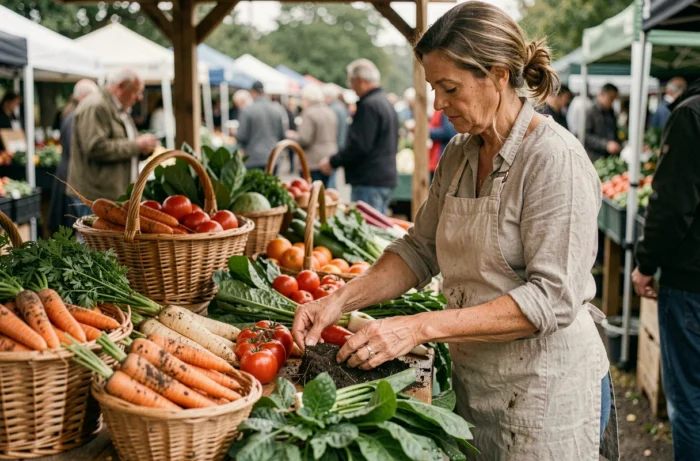
A farm product refers to a food item produced on the farm, processed and sold by the same producer. This direct traceability, from field to plate, distinguishes farm products from industrial products or those simply labeled “local” in supermarkets. Understanding this difference allows for more informed food choices, both nutritionally and regulatory-wise.
Regulatory traceability of local farm products: what changes concretely
Traceability no longer relies solely on trust between consumer and producer. The French legislative framework has evolved significantly in recent years, with direct consequences on what ends up on our plates.
The emergency agricultural law enacted in August 2026 now requires public collective catering to prioritize supplies from the European Union, the European Economic Area, or certain partner territories, except in specific exceptions. This obligation goes beyond mere discourse on “eating local”: it structures public purchases and encourages school, hospital, and administrative canteens to turn to verifiable local supply chains.
At the same time, the display of origin is being extended to new categories of ingredients in prepackaged goods. Fish flesh or eggs from aquaculture and bivalve mollusks will need to indicate their origin, with certain provisions coming into effect no later than January 1, 2028. This increased transparency directly benefits local farm producers, whose products already carry an identifiable origin without ambiguity.
The Ma Cantine tracking system has also been strengthened in 2026. Establishments must more precisely declare the origin from France, the European Union, and the EEA in their supplies, through a simplified online declaration. When purchasing directly from a farm producer, this traceability chain is shortened to the maximum.
Some producers, like those listed on lafermedumidi.fr, offer direct sales that make this traceability clear for the end consumer, without intermediaries or complex labeling.
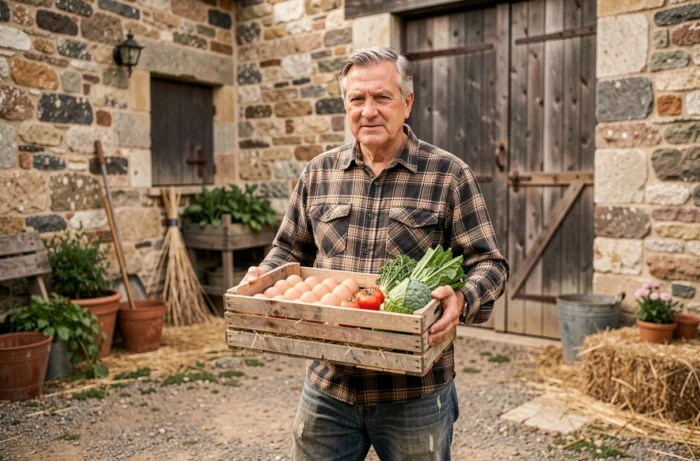
Nutritional quality of seasonal farm foods
A fruit or vegetable harvested at maturity on a local farm does not have the same nutritional profile as a product picked green, ripened in cold storage, and then transported over long distances. The difference lies in the timing of the harvest.
Seasonal farm products retain more nutrients because they undergo neither prolonged storage nor the addition of external agents to maintain their appearance. A vegetable that goes from the ground to the stall in a few hours retains its vitamins, minerals, and flavors intact.
This benefit is not trivial. Seasonality imposes a natural rotation of consumed foods, diversifying nutritional intake without particular planning effort. Eating squash in the fall, asparagus in the spring, and tomatoes in the summer covers a broader spectrum of micronutrients than a monotonous diet based on products available year-round.
What seasonality concretely brings to your plate
- Fruits and vegetables harvested at maturity, naturally richer in taste and vitamins, without resorting to post-harvest treatments
- A spontaneous dietary diversification dictated by the agricultural calendar, which prevents monotony and covers a wide range of nutrients
- A reduced shelf life that encourages cooking with fresh products, limiting the consumption of ultra-processed foods
Buying farm-fresh and seasonal aligns eating habits with the biological rhythm of crops rather than the industrial logic of constant availability.
Impact of local consumption on producers’ economy
When a consumer buys cheese or a basket of vegetables directly from the farm, the entire sale price goes back to the producer. In long supply chains, the producer’s margin shrinks as intermediaries pile up: cooperative, wholesaler, purchasing center, distributor.
This direct remuneration has a concrete consequence: it allows small farms to maintain their activity without solely depending on prices set by large retailers. For small farms, short supply chains are not an additional source of income; they are often a condition for economic survival.

HVE certification and EGAlim objectives: a point of vigilance
Farms engaged in an environmental approach sometimes turn to High Environmental Value (HVE) certification. Level 2 HVE certification will no longer count towards EGAlim objectives starting January 1, 2027. Only level 3, the most demanding, will be taken into account in the calculation of sustainable supplies in collective catering.
For farm producers, this tightening of EGAlim criteria values farms that are genuinely committed to sustainable agricultural practices. It excludes intermediate certifications that sometimes served as a facade without deep transformation of production methods.
Local food and reduction of environmental footprint
Transport represents a variable but significant part of the carbon footprint of food. Reducing the distance between the place of production and the place of consumption mechanically decreases emissions related to logistics.
The environmental argument for local does not stop at transport. Local farm products generally follow less intensive agricultural practices, with crop rotations, limited use of chemical inputs, and respect for the natural rhythm of soils. These practices contribute to the preservation of biodiversity and soil fertility in the long term.
- Fewer kilometers traveled between harvest and sale, thus less CO2 emissions related to transport and refrigeration
- Production methods that are often extensive, preserving soils, groundwater, and local wildlife
- Less reliance on industrial packaging when sales are made directly, at markets, or on the farm
Choosing local does not alone erase the environmental footprint of a diet. The type of production (intensive farming versus market gardening, for example) sometimes weighs more than the distance traveled. Prioritizing local and seasonal farm products combines the two most effective levers: geographical proximity and agronomic coherence.
The next regulatory deadline to watch is January 1, 2028, the deadline for extending origin labeling on prepackaged products. This obligation will further enhance the clarity of provenance, a structural advantage for farm producers who have never needed to hide where their food comes from.