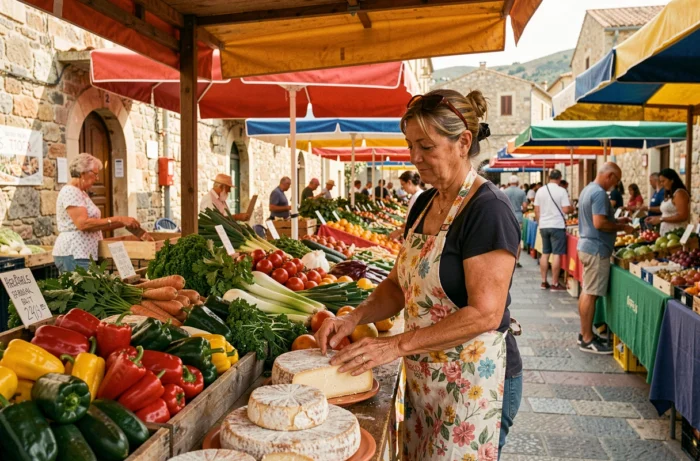
Porto Torres is often reduced to its ferry port, a mere stop before heading to Alghero or Stintino. However, its market tells a different story, that of a town where artisanal fishing and agricultural production from the Nurra plain continue to shape daily life. Understanding what unfolds here is to grasp a side of Sardinia that classic beach circuits overlook.
Artisanal Fishing and Porto Torres Market: A Living Link
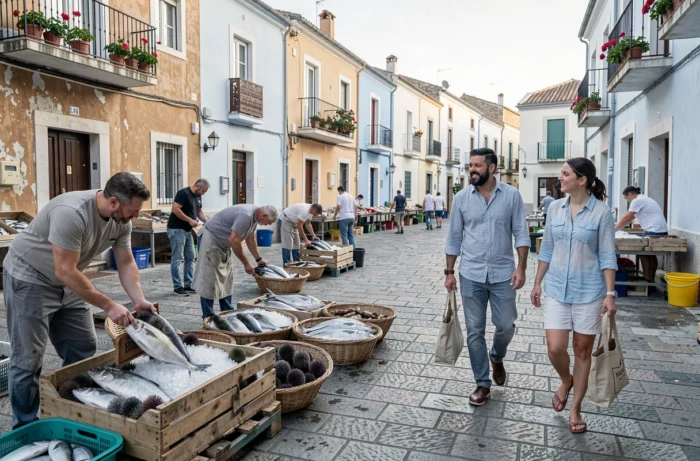
Have you ever noticed the difference between a fish sold that very morning at a stall and one packaged in a tray for several days? In Porto Torres, this distinction is visible, tangible, and flavorful. The town remains an active fishing port, and this activity directly structures the offerings of the local market.
Fishing competitions like the Trofeo Martiri Turritani regularly gather about twenty teams in the Gulf of Asinara. This is not folklore: artisanal fishing remains a cornerstone of local culture, and it supplies the stalls with fresh products that cannot be found in the supermarkets of the tourist coast.
Specifically, this means that visitors who take the time to visit the Porto Torres market gain access to fish, shellfish, and crustaceans caught in nearby waters, often on the same day or the day before. Local fishermen favor the bolentino technique, a vertical line fishing method suited to the rocky bottoms of the gulf.
Sardinian Products from the North of the Island: What You Can Find at the Stalls
The market is not limited to fish. The Nurra plain, which stretches between Porto Torres, Sassari, and Alghero, supplies part of the fruits and vegetables, cheeses, and charcuterie found on-site.
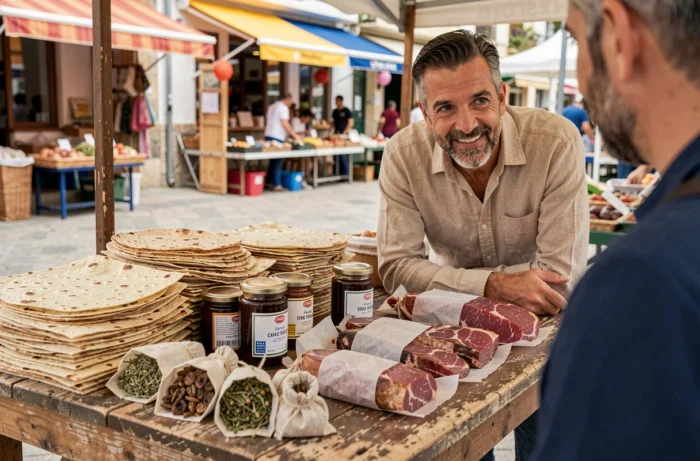
Sheep’s cheeses dominate the cheese offerings. Sardinia produces the majority of Italian pecorino, and the stalls in Porto Torres offer versions at different stages of aging, from creamy fresh to very dry stagionato. Asking to taste before buying is customary; there’s no need to know Sardinian to point it out.
On the vegetable side, the seasons dictate the contents of the crates. At the end of summer, tomatoes, prickly pears, and eggplants occupy most of the space. In spring, artichokes and fava beans take over. This strict seasonality sometimes surprises visitors used to supermarkets where everything is available year-round.
- Sheep’s cheeses (fresh pecorino, semi-aged, aged): to taste on-site to choose the aging that suits you
- Local charcuterie: dry sausage with wild fennel, Sardinian prosciutto, lard seasoned with herbs from the maquis
- Pane carasau: the typical crunchy flatbread, sold in large sheets that are broken by hand
- Honey from the Mediterranean maquis: a bitter and lingering taste, very different from common floral honeys
Piazza Garibaldi and Neighborhood Life: The Market as a Social Space
The market does not exist in a vacuum. It is embedded in a compact urban fabric, around Piazza Garibaldi, which serves as a convergence point for locals. The municipality organizes summer events as part of the “Estate in Piazza Garibaldi” program, blending outdoor activities and commercial life.
This detail changes the visitor’s experience. Where an isolated market can be explored in twenty minutes, the Porto Torres market integrates into a broader stroll. One can follow up with a coffee in the square, pass by the Basilica of San Gavino (the largest Romanesque church in Sardinia), and then return to pick up what was spotted in the morning.
The market functions as a daily meeting place, not as a one-time attraction. Regulars come several times a week. Observing their habits, listening to exchanges with vendors, provides access to a rhythm of life that beaches do not reveal.
Porto Torres Market or Tourist Supermarket: Why the Choice Matters
In northern Sardinia, tourist areas around Stintino or the Costa Smeralda offer shops tailored for vacationers. Prices are higher there, and products are often standardized to please the largest number.
The Porto Torres market operates on a different logic. Prices remain aligned with local purchasing power, as the clientele is predominantly made up of residents. Buying at the local market is significantly cheaper than in tourist areas, often with superior product quality.
Why does this choice matter for a stay? Because it transforms the way one eats during vacation. A rental apartment in Porto Torres or the surrounding area, combined with shopping at the market, allows for the preparation of authentic Sardinian meals without always going through a restaurant.
- Fresh fish from the Gulf of Asinara grilled with a drizzle of local olive oil
- Sardinian antipasto: pecorino, charcuterie, pane carasau, garden tomatoes
- Fregola with seafood, a recipe that fish vendors are happy to explain
When to Go and How to Make the Most of It
The morning is the best time for the market. Fish stalls empty quickly, and fruit and vegetable producers pack up in the early afternoon. Arriving before mid-morning ensures the widest selection.
Combining Market and Historical Visit of Porto Torres
The town is easy to explore on foot. From the market, the Roman ruins of Turris Libisonis and the Basilica of San Gavino are just a few minutes’ walk away. This compact format allows for filling half a day without a car, which is rare in this part of the island where everything seems designed for motorized transport.
Porto Torres may not have the immediate photogenic appeal of Alghero or the iconic beaches of Stintino. What it offers through its market is direct access to daily Sardinian life, to the products of the land and sea from the north of the island, without a tourist filter. For a stay in Sardinia that goes beyond the postcard, this is precisely where it happens.