
A plot exposed to full south in the Var hinterland, a limestone soil that turns white by June, watering restrictions that come into effect every summer: this is the concrete starting point when looking for grass for a Mediterranean region. The choice of seeds is not made from a catalog; it is made by crossing the reality of the soil, local drought orders, and the intended use of the lawn.
Drought orders and Mediterranean grass: the framework that dictates the choice
Before even discussing varieties, we must integrate a constraint that changes everything. In most Mediterranean departments of France, drought orders limiting or prohibiting the watering of lawns in summer are repeated every year, with a gradual tightening after 2022. In practical terms, grass that requires regular watering in July-August has become a poor investment.
When the alert level moves to “crisis,” watering gardens is strictly prohibited. A classic lawn primarily based on English ryegrass, which is water-hungry, turns yellow in a few weeks and takes months to recover. You end up with a brown patch throughout the beautiful season, which negates the interest of having sown.
The number one criterion is therefore no longer aesthetics or the fineness of the blade, but the ability to survive without summer watering. This filter directs towards very specific seed compositions and immediately rules out “universal” mixes sold in supermarkets.
To deepen the varietal selection according to these constraints, the file dedicated to grass suitable for Mediterranean climates details the recommended compositions zone by zone.
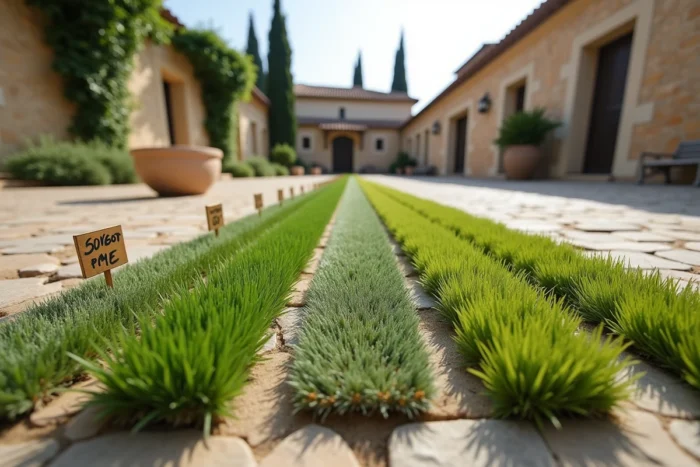
Tall fescues and C3/C4 mixes: the grasses that withstand the heat
Not all grasses react the same way to heat. Two main families are distinguished according to their photosynthetic metabolism: C3 species and C4 species. This distinction helps to understand why some lawns remain green while others scorch.
Tall fescues, the backbone of Mediterranean grass
Tall fescue (Festuca arundinacea) is the most suitable C3 grass for dry soils and high temperatures. Its root system goes significantly deeper than that of English ryegrass, allowing it to seek residual moisture in the subsoil. It also tolerates limestone and compact soils, which are common in the south of France.
A mix containing at least half tall fescue forms the most reliable base for a Mediterranean lawn. It is often combined with creeping red fescue, which is finer, densifying the surface mat and improving the visual appearance.
The contribution of improved Cynodon dactylon (C4)
Recent compositions include a proportion of improved Cynodon dactylon, a C4 grass that actively grows when temperatures exceed 30 °C, where C3 grasses slow down. These hybrid C3/C4 mixes anticipate climate warming and increasingly long summers.
Cynodon provides summer resistance, while fescues take over in the transitional seasons. Feedback varies on this point: in very shaded gardens, Cynodon struggles to establish itself properly. This type of mix is especially suitable for sunny plots, exposed to at least six hours of sunlight per day.
Soil preparation in limestone and stony terrain
Choosing the right seeds is not enough if the soil is not prepared. In Mediterranean areas, we often work on a limestone substrate, sometimes very stony, with a thin layer of topsoil.
- Remove surface stones to about fifteen centimeters and incorporate mature compost to increase the soil’s water retention capacity. Pure limestone soil drains water too quickly.
- Test the pH before sowing: fescues tolerate a high pH, but an excessively basic soil hinders the germination of ryegrass if the mix contains it.
- Roll the soil after sowing to press the seeds into the substrate. In dry terrain, a seed suspended in warm air does not germinate.
The classic mistake is to sow on unamended soil relying on watering to compensate. With summer restrictions, this strategy no longer holds.
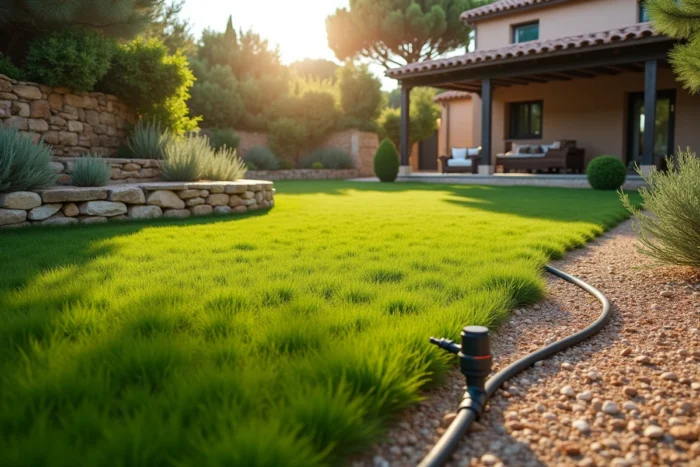
Sowing and maintaining grass in dry climates: the calendar that changes everything
In the Mediterranean, sowing does not occur at the same time as in northern France. Spring is often too short: temperatures rise quickly, and young shoots do not have time to root before the first heat.
The optimal window is in autumn, between September and mid-November, when the first rains return and the soil retains the heat accumulated in summer. Germination is rapid, and the roots have all winter to settle deeply before the next summer stress.
Mowing and cutting height in summer
Mowing too short during hot periods is another common mistake. In a Mediterranean climate, the cutting height is maintained at a minimum of seven or eight centimeters during summer. A slightly longer blade shades the soil, limits evaporation, and protects the shallow roots.
The frequency of mowing naturally decreases: adapted grasses slow down their growth when the heat intensifies. Forcing a weekly mow in the middle of summer stresses a lawn already in survival mode.
Reasoned watering when it is still allowed
In the transitional seasons, when watering is still permitted, long and spaced sessions are preferred over short daily applications. The goal is to force the roots to go down and seek water deeply. Superficial watering keeps the roots near the surface, making the lawn vulnerable as soon as the ban is imposed.
The choice of Mediterranean grass ultimately hinges on three concrete decisions: seeds predominantly of tall fescue (with or without Cynodon depending on sunlight), amended soil before sowing, and a calendar aligned with autumn. The rest, the perfect color, the fineness of the blade, takes a back seat when the priority is to have a lawn still green after a summer without watering.