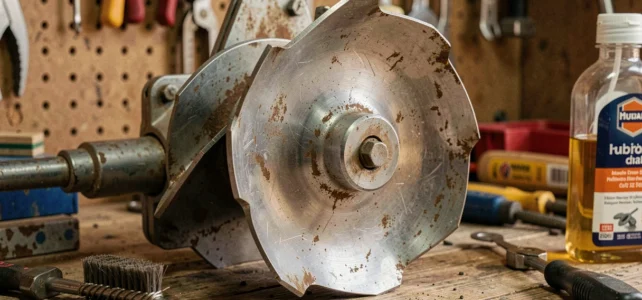
A helical blade does not cut grass: it shears it. The cylinder, made up of several blades arranged in a spiral, presses each blade against a fixed counter-blade, just like the two cutting edges of scissors would. This mechanical principle radically distinguishes the helical mower from the rotary mower, which tears the grass by impact.
Cylinder and counter-blade: the scissor cutting mechanism
The heart of the system relies on two complementary elements. The cylinder carries between three and ten curved blades, welded or bolted in a spiral around a horizontal axis. As it turns, these blades draw each blade of grass towards the fixed counter-blade, a straight steel bar positioned just below.
The quality of the cut depends almost entirely on the gap between the cylinder and the counter-blade. When this gap is correct, the blade is cut cleanly, and the healing of the plant is quick. A gap that is too wide allows the grass to bend without being cut, producing whitish fringes visible to the naked eye after a few days.
On a manual model, the rotation of the cylinder is generated by the wheels on the ground: by pushing the mower, the gears transmit the movement. The thermal or electric versions directly motorize the axis of the cylinder, allowing for increased rotation speed and accommodating slightly taller grass. Understanding how a helical lawn mower blade works helps to better choose between these motorizations depending on the area and type of lawn.
Adjusting the cylinder-counter-blade gap: the decisive technical gesture
No other adjustment influences the final result as much. The gap between the cylinder and the counter-blade is checked with a simple sheet of newspaper slipped between the two elements. When the rotating blade cleanly cuts the paper across its entire width, the contact is good.
If the paper crumples or bends without being cut in certain places, the adjustment screws located at both ends of the cylinder need to be adjusted. This adjustment is made in small increments, a quarter turn at a time, alternating between the left and right sides to maintain a perfect parallelism between the cylinder and the counter-blade.
Too tight a contact causes accelerated wear of both parts, overheating in motorized models, and a significantly heavier pushing effort on manual mowers. The right compromise is reached when the paper is cut without the blades rubbing metal against metal.
Sharpening and backlapping: two methods, two uses
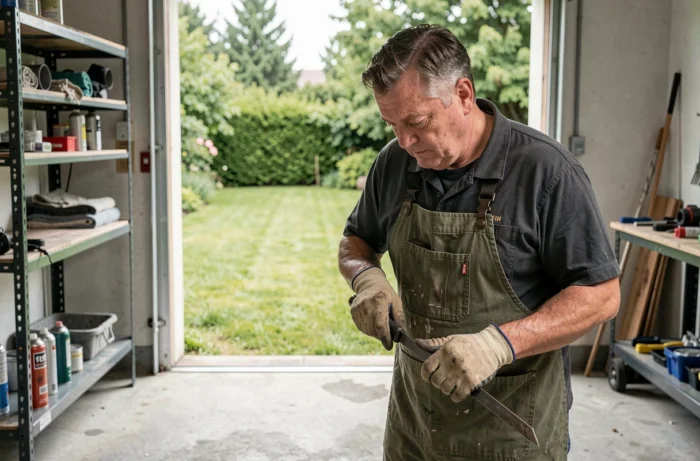
Traditional sharpening involves disassembling the cylinder and grinding each blade on a grinding bench, or having a professional sharpener equipped with a dedicated grinder intervene. This operation restores the original profile of the blades and is suitable when wear is pronounced or a shock has created a notch.
Backlapping offers a less invasive alternative, widely used in the maintenance of sports lawns. The principle involves applying an abrasive paste to the blades and then rotating the cylinder in reverse. The controlled friction between the blades and the counter-blade recreates a fine edge without disassembly.
- Backlapping is performed after a few dozen hours of mowing, before the blades show visible signs of wear.
- The abrasive paste used varies in grain depending on the condition of the blades: a fine grain is sufficient for regular maintenance, while a medium grain corrects slight dullness.
- On manual mowers, backlapping can be done by turning the wheels by hand in the opposite direction of travel after coating the blades with paste.
- High-end motorized models sometimes have a reverse function for the cylinder, facilitating the operation without special handling.
The signs indicating a need for sharpening are concrete: the mowed grass has frayed or browned tips, the mower pulls more to one side, or the cutting noise changes tone. Torn blades rather than cut ones signal a dull blade.
Regular maintenance of the helical mower: the important gestures
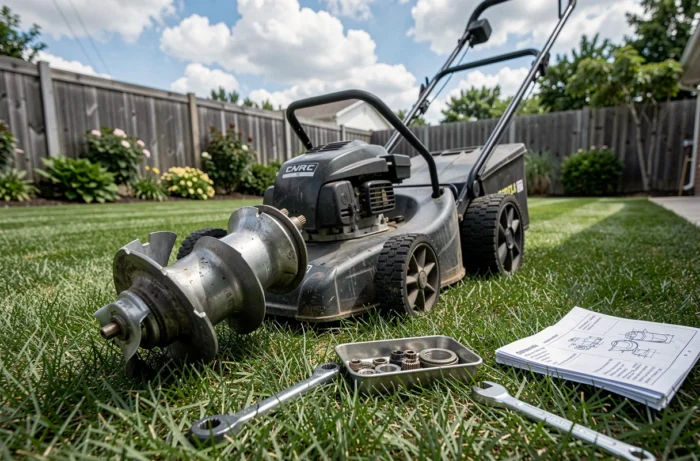
After each mowing, cleaning the cylinder and the counter-blade prevents the accumulation of sap and plant residues. Dried sap forms a sticky layer that alters the cutting gap and promotes corrosion. A simple jet of water followed by wiping with a dry cloth is sufficient in most cases.
Lubrication and rust protection
The blades and the counter-blade benefit from a thin layer of oil after cleaning, especially if the mower is stored in a humid environment. A vegetable oil or light engine oil applied with a brush protects the metal surfaces between uses.
For thermal models, checking the engine oil level and the condition of the air filter is added to the blade checks. A clogged filter reduces engine power and slows down the cylinder speed, which indirectly degrades the quality of the cut.
Winter storage
At the end of the season, a final light backlapping prepares the blades for winter rest. The cylinder, well-oiled, remains protected for several months. On a thermal model, emptying the fuel tank or adding a stabilizer prevents carburetor clogging.
- Store the mower in a dry place, protected from temperature fluctuations.
- Never leave the blades in permanent contact with the counter-blade during prolonged storage to avoid oxidation marks at the contact point.
- Check the condition of the cylinder bearings before putting it back into service in the spring.
European regulation and blade maintenance documentation
Regulation (EU) 2023/1230, which will replace Directive 2006/42/EC and become mandatory for any new machine placed on the market from January 20, 2027, strengthens the requirements related to maintenance documentation. Manufacturers will need to include in their manuals a risk analysis covering the entire life cycle, including sharpening operations, adjustment of the cylinder-counter-blade contact, and handling of the returned machine.
For users, this means that upcoming manuals provided with a helical mower will detail backlapping procedures and recommended replacement intervals more thoroughly. More precise information from the manufacturer will directly benefit the longevity of the blades and the safety of the operator.
The care given to the cylinder-counter-blade pair conditions everything else. A lawn mowed with well-adjusted and regularly sharpened blades heals faster, resists fungal diseases better, and maintains a uniform color that rotary mowing cannot replicate.