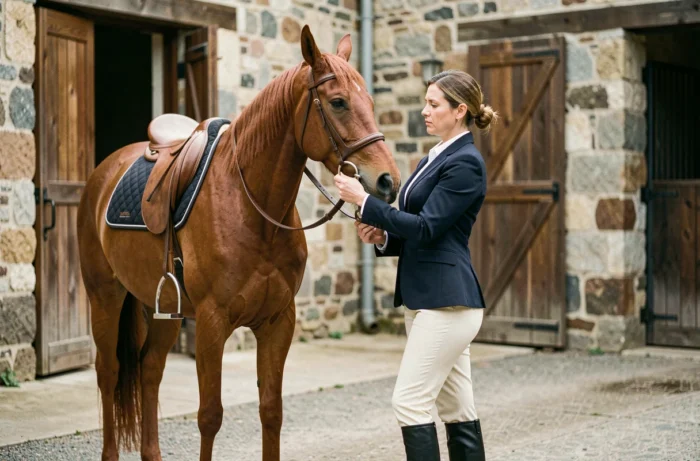
Equestrian equipment is divided into two distinct categories: what protects the rider and what preserves the horse. Choosing between these pieces requires understanding their actual function, not just their name. In recent years, purchasing criteria have significantly evolved: the priority given to the horse’s well-being and biomechanics is changing the hierarchy of essential equipment for riders and horses.
Rider Safety and Current Standards: What Has Changed
Most equipment guides mention the helmet as a mandatory piece, without detailing the regulatory requirements. Recent models comply with the EN 1384:2023 standard, an updated version that replaces older European references.
This standard strengthens the criteria for shock absorption and cranial coverage. A helmet compliant with an earlier standard does not offer the same level of protection. Checking for certification on the inner label remains the only reliable way to ensure compliance.
The back protection vest, mandatory in eventing, protects the spine in case of a fall. Outside of competition, wearing it is still recommended for cross-country and outdoor work. To find equipment that meets these requirements, a useful resource is: https://www.equitorne.fr/, which offers a catalog covering saddlery and safety equipment.
Comparison of Equipment by Function
Rather than listing each item, grouping equipment by function allows for a clearer view of what pertains to safety, comfort, or daily care.
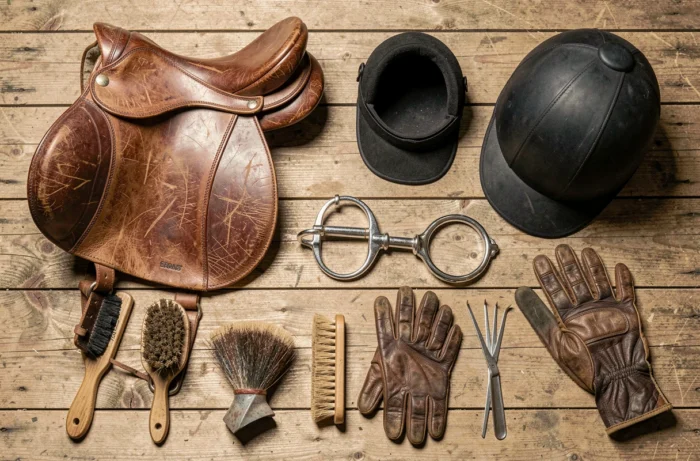
| Function | Rider Equipment | Horse Equipment |
|---|---|---|
| Physical Protection | Helmet (EN 1384:2023), protective vest | Boots, gaiters, fetlock protectors |
| Contact and Direction | Gloves, reins | Bridle, bit, halter, and lunge line |
| Sitting and Comfort | Riding pants, boots or booties with mini-chaps | Saddle, saddle pad, girth |
| Daily Care | – | Curry comb, brush, hoof pick |
| Climate Protection | Waterproof jacket | Blanket (indoor/outdoor) |
This table reveals a clear gap: horse equipment covers more functions than rider equipment. The expenses related to the horse are more numerous and vary more depending on the discipline practiced.
Saddle and Bridle: Where the Horse’s Well-Being Really Matters
The saddle is the most expensive and crucial piece for the horse’s back health. An ill-fitting saddle pad or an unsuitable saddle for the animal’s morphology causes pressure points on the withers and the back.
According to a report published by Grand Prix in August 2026, sales of comfort and biomechanics-oriented equipment have been significantly increasing over the past three to five years. The founder of West Cheval saddlery testified that she reorganized her offerings to meet this growing demand.
The bridle follows the same logic. Recent models distribute pressure better on the horse’s neck. In contrast, constraint devices, particularly German reins, are experiencing a significant decline in sales. This shift reflects a documented change in mindset among owner riders.
Concrete Criteria for Checking Saddle Fit
- The wither clearance should allow two fingers to pass vertically between the pommel and the horse’s withers, without direct contact
- The padding should rest evenly on the back, without lateral tilting or voids under the panels
- The girth should not pinch the skin behind the elbow: a flat hand’s space between the elbow and the girth indicates correct positioning
These checks take less than two minutes and prevent chronic back pain in the horse.

Bits and Mouthpieces: The Most Underestimated Choice
The bit is often treated as a standard accessory, while it is the main point of contact between the rider’s hand and the horse’s mouth. A bit that is too wide rattles in the mouth and injures the corners. A bit that is too narrow compresses the palate or bars.
The type of bit varies according to the discipline and the horse’s sensitivity. A single-jointed snaffle bit is suitable for most horses in regular use. Jointed bits provide better lateral stability for young horses in training.
The FEI has announced new rules regarding tack and equipment in show jumping effective from 2027. These regulatory developments confirm that the choice of mouthpiece is increasingly being regulated at the international level.
Daily Care Equipment: The Often Neglected Foundation
Daily grooming is not a matter of unnecessary comfort. The curry comb, brush, and hoof pick allow for early detection of injuries, swelling, or foot problems such as thrush.
- The curry comb (rubber or plastic) removes embedded dirt and stimulates blood circulation under the skin
- The soft brush removes fine dust and smooths the coat after using the curry comb
- The hoof pick clears stones and compacted dirt from the sole, preventing hoof abscesses
- The halter and lunge line are used to safely tie and move the horse during care
This care equipment represents a modest investment compared to saddlery, but its daily use makes it the most utilized equipment for the owner rider.
The underlying trend documented in recent years is reshaping the notion of essential equipment. The focus is shifting from performance to the preservation of the horse, and manufacturers are adapting their ranges accordingly. Well-fitted equipment that complies with current standards remains the primary factor for safety and longevity, for both the rider and their mount.