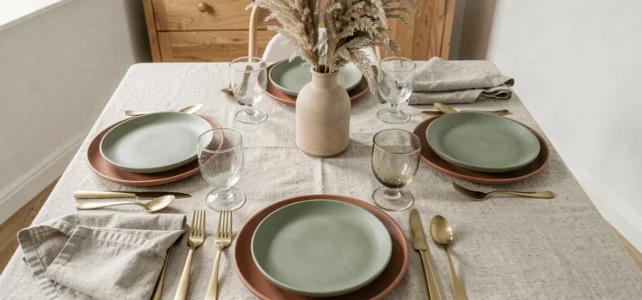
When hosting at home on a Saturday night and opening the cupboard, the observation is often the same: classic white plates seem dull, the inherited service no longer matches the rest of the decor. Tableware and table decoration now follow the same cycles as furniture or textiles. The collections released this year confirm specific directions, driven by new regulatory constraints and a clear taste for raw materials.
European standards on glazes: what changes for decorative tableware
Before discussing colors or shapes, a technical point deserves attention. Since 2024, the European Union is tightening the limits on the migration of heavy metals (lead, cadmium, nickel, among others) in materials that come into contact with food. For ceramic and decorated porcelain tableware, this has direct consequences.
We are increasingly seeing the mention “food safe” on collections, including those sold as purely decorative. Manufacturers are reformulating their glazes and colorants to remain compliant. Specifically, pieces with very bright or metallic glazes are becoming rarer in food ranges, which naturally directs palettes towards softer shades or matte finishes.
This tightening also pushes brands to better document the origin of their pigments. When choosing tableware from La Table de Jeanne, you will find this traceability logic in the product sheets, with clear indications on the food compatibility of decorated pieces.
Stoneware and artisanal textures: the tableware trend that is here to stay
Stoneware dominates the new collections, and not just as an aesthetic argument. This high-temperature fired material is more resistant to thermal shock than classic earthenware. You can move it from the oven to the table without risk, which corresponds to how we actually eat: shared dishes, last-minute cooking, direct presentation.
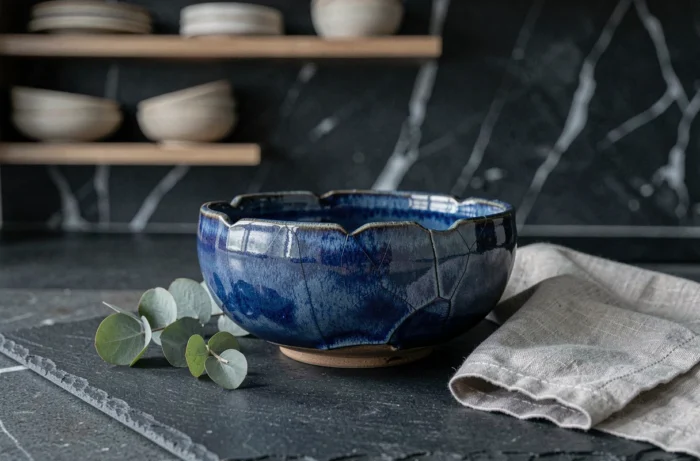
Textured surfaces are part of the same movement. Rather than a smooth and uniform glaze, the pieces feature intentional irregularities, dripping effects, and slightly asymmetrical edges. The reactive glaze makes each piece visually unique, giving the impression of a service that is composed rather than bought as a set.
Reactions vary on this point: some find these irregularities appealing, while others perceive them as flaws. The best approach is to handle the pieces before purchase when possible, or to order a single plate to test the appearance.
Organic shapes and plates with irregular edges
Classic round plates are losing ground to oblong, oval, or wavy-edged shapes. On a table, mixing two plate shapes creates a natural composition effect without the effort of staging. For example, one might pair an oval flat plate with a slightly smaller round bowl, playing with closely related shades.
Trendy colors and patterns for table decoration this year
This year’s palettes are organized around two axes. The first favors muted and earthy tones: sandy beige, sage green, clay brown, off-white. These colors blend together effortlessly, simplifying everyday table setting.
The second axis, more pronounced, focuses on deep colors: cobalt blue, burgundy, forest green. They are mainly found on accent pieces (a serving platter, a pitcher, candles) rather than on the entire service.
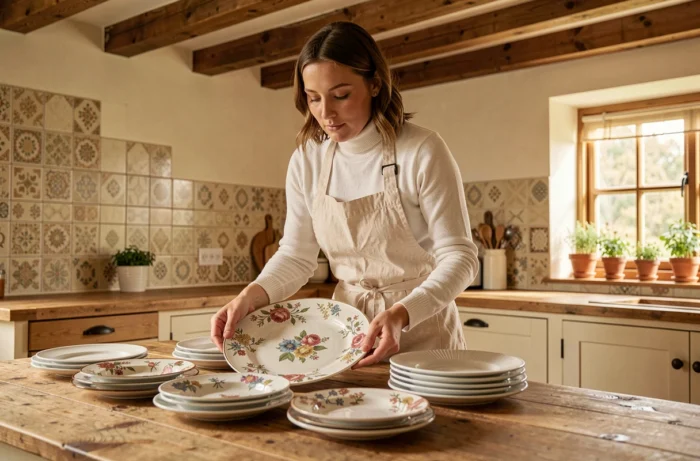
- Floral patterns are making a comeback, but in stylized and monochrome versions, far from the saturated country style.
- Fine stripes and discreet geometric patterns appear on glass and carafe collections.
- White remains a safe base, provided it is enhanced by colored linen tablecloths or placemats.
Creating a mismatched service without a false note
The mismatched service has become a reflex, but it works as long as there is a common thread. Choosing a single material family (all stoneware or all porcelain) avoids the flea market effect. You can then vary colors freely, staying within the same range of warm or cool tones.
Another useful guideline: keep the same format of flat plate for all guests and vary only the bowls or dessert plates. Consistency comes from the silhouette, not the color.
Durable and eco-friendly tableware: beyond marketing talk
The durability of tableware is becoming a concrete selection criterion, not just a label argument. In the restaurant and hospitality sectors, the longevity of pieces and their compatibility with intensive use are now part of formal specifications.
For domestic use, the question arises differently. We look for pieces that age well, that do not chip after a few dishwasher cycles, and whose manufacturing limits environmental impact.
- High-temperature stoneware withstands repeated washing cycles better than earthenware or glazed terracotta.
- Fine porcelain collections remain relevant for festive meals but require more precautions.
- Items made from compostable materials (bagasse, palm leaf) are progressing in the event segment, driven by bans on single-use plastics.
The best durable tableware, in practice, remains that which we use every day without relegating it to the back of the cupboard. A well-chosen stoneware service easily lasts a decade, which puts the initial purchase price into perspective compared to frequent replacements of fragile pieces.
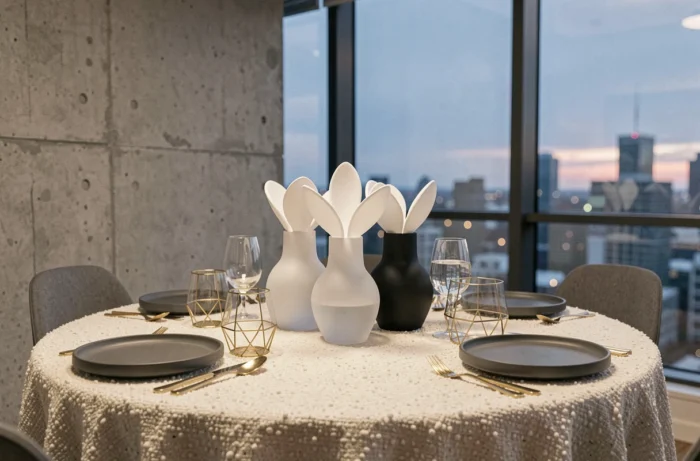
What distinguishes this year’s trends from previous ones is the convergence of regulatory constraints, a taste for artisanal work, and a demand for robustness. We no longer decorate our table for the photo; we choose pieces that work in daily life and stand the test of time. The perfect setting has given way to a freer approach, where each meal composes its own table.